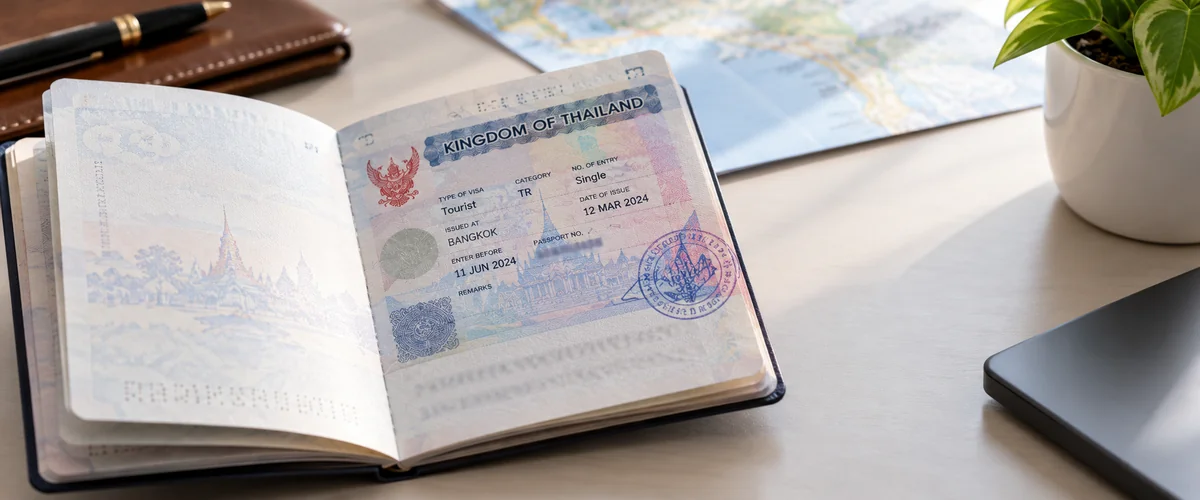
Thailand Retirement Visa 2026: Non-O, O-A and O-X Explained
If you are 50 or over you can live in Thailand on a year-to-year retirement permission. It is renewed every 12 months. To qualify you need to show 800,000 THB in a Thai bank account, income of at least 65,000 THB a month, or a combination of the two adding up to 800,000 THB a year.
There are three routes. Most Pattaya retirees use the first:
- Non-Immigrant O (retirement): a 90-day visa, or a conversion inside Thailand, followed by a one-year extension at Jomtien immigration. No health insurance is required for the extension.
- Non-Immigrant O-A: a one-year visa applied for from abroad. It needs health insurance of at least 3,000,000 THB (USD 100,000), a police certificate and a medical certificate. Extensions based on an O-A entry need the same insurance.
- Non-Immigrant O-X: a 5+5-year visa for 14 nationalities, including the UK, US, Australia and Canada. It needs 3,000,000 THB in Thailand.
None of these routes allows you to work.
| Minimum age | 50 (all three routes) |
|---|---|
| Money (Non-O / O-A) | 800,000 THB in a Thai bank, or 65,000 THB/month income, or a combination totalling 800,000 THB a year |
| Money (O-X) | 3,000,000 THB in a Thai bank, or 1,800,000 THB in Thailand plus 1,200,000 THB a year in income |
| Health insurance | Non-O-based extension: not required. O-A visa and O-A-based extension: ≥ 3,000,000 THB / USD 100,000. O-X: Thai-issued long-stay insurance |
| Extension fee (government) | 1,900 THB per year |
| Length of each permission | 1 year (Non-O extension, O-A entry). O-X: 5 years, renewable once |
| Work allowed? | No. Paid or unpaid work needs a different visa and a work permit |
| Ongoing duties | 90-day reports, TM30 address registration, re-entry permit before any trip abroad |
Which retirement visa is right for me: Non-O, O-A or O-X?
All three are "retirement visas", but they are applied for in different places and come with different conditions. Many websites call everything an "O-A", which causes expensive mistakes. The O-A insurance rule, for example, does not apply to someone on a Non-O-based extension.
| Non-O + 1-year extension | Non-O-A | Non-O-X | |
|---|---|---|---|
| Where you apply | Non-O visa from a Thai embassy / e-Visa, or converted at a Thai immigration office; then a 1-year extension at your local immigration office (Jomtien for Pattaya) | Thai e-Visa portal / embassy in your country of nationality or residence only | Thai e-Visa portal / embassy (eligible nationalities only) |
| First permission | 90 days, then 1-year extension | 1 year from entry (visa valid 1 year multiple entry; a last-day entry can give close to 2 years) | 5 years, renewable once for another 5 |
| Financial proof | 800k THB / 65k THB per month / combination | 800k THB / 65k per month / combination (may be held abroad for the visa application, depending on the embassy) | 3M THB, or 1.8M THB plus 1.2M THB annual income |
| Health insurance | Not required for the extension | ≥ 3,000,000 THB or USD 100,000 | Thai insurer, long-stay policy |
| Police certificate & medical certificate | Not for the extension | Yes, both | Yes, both |
| Best for | Most people already in Thailand, or anyone who wants to avoid compulsory insurance | People who want to arrive with a full year already granted | Wealthier retirees from eligible countries who want fewer renewals |
See our detailed comparison: Non-O vs Non-O-A retirement visa.
Who qualifies for a Thai retirement visa?
- Age 50 or over on the day you apply. There is no upper age limit.
- Any nationality for Non-O and O-A. The O-X is limited to Japan, Australia, Denmark, Finland, France, Germany, Italy, the Netherlands, Norway, Sweden, Switzerland, the UK, Canada and the USA.
- Enough money under one of the methods below.
- No serious criminal record and not on the immigration blacklist. A police certificate is required for O-A and O-X applications.
- Your spouse or partner under 50 can usually stay as your dependant on a Non-O. Thai immigration does not normally accept unmarried partners as dependants, so each partner may need their own visa. See our guide to bringing a spouse.
How much money do I need for a Thai retirement visa?
For the Non-O-based extension (and the O-A), you must meet one of three financial tests. These are set out in clause 2.22 of the Immigration Bureau's extension criteria. That order has been reissued since 2014, but the figures have not changed.
1. Lump sum: 800,000 THB in a Thai bank
- The account must be in your own name at a Thai bank. A joint account with a spouse is usually accepted if your name is on it, but check first.
- Before applying: the 800,000 THB must have been in the account for at least 2 months before you file the first extension. For later renewals, offices including Pattaya generally expect the full 800,000 THB to have been in place for 3 months before you apply.
- After approval: the full 800,000 THB must stay in the account for 3 months. After that you may spend down to 400,000 THB, but never below it, for the rest of the year.
- Immigration checks this at your next renewal from your bank book, so keep it updated.
2. Monthly income: at least 65,000 THB a month
- Pension, annuity or other regular income counts.
- Several embassies, including the British, US and Australian, no longer issue the income letters immigration used to accept. In practice most people now show 12 months of transfers from abroad into a Thai bank account of at least 65,000 THB each month, with bank statements and a bank letter confirming the transfers came from overseas.
- Exchange-rate falls matter. If the pound or dollar drops and a monthly transfer arrives below 65,000 THB, that month may not count. Send a margin above the minimum.
3. Combination: income plus savings totalling 800,000 THB a year
For example, 25,000 THB a month in income (300,000 THB a year) plus 500,000 THB in a Thai account. Offices expect the deposit part to be seasoned in the same way as the lump-sum method. Pattaya applies its own checks, so confirm the exact combination with us or the office before relying on it.
The full breakdown, with worked examples, is in Retirement Visa Financial Requirements 2026.
Do I need health insurance for a Thai retirement visa?
It depends on which visa you entered on. This is the most misunderstood rule in Thai retirement immigration.
- Non-O (retirement) entry, then a 1-year extension: no health insurance is required by immigration. (We still strongly recommend it. See our healthcare guide.)
- O-A visa application from abroad: insurance covering your whole stay with total coverage of at least 3,000,000 THB or USD 100,000. This replaced the old "40,000 THB outpatient / 400,000 THB inpatient" rule. The MFA guideline took effect on 1 October 2021.
- Extensions based on an O-A entry: immigration applies the same 3,000,000 THB / USD 100,000 minimum. If you hold an O-A-based extension and cannot get insurance, ask us about switching to a Non-O-based extension. This usually means leaving Thailand and re-entering on a Non-O.
- O-X: health insurance from a Thai insurer. The Thai General Insurance Association (TGIA) lists approved long-stay policies.
More detail, including what to do if you are refused cover because of age or pre-existing conditions: Retirement Visa Insurance Requirements 2026.
What documents do I need for a retirement extension in Pattaya?
The typical set for a Non-O-based retirement extension at Pattaya (Jomtien) immigration is below. Officers can ask for more.
- Form TM.7 (application for extension of stay), completed and signed, with one 4×6 cm photo
- Passport, plus signed copies of the photo page, current visa or extension stamp, latest entry stamp and departure record, and any re-entry permit
- TM.30 receipt showing your current address
- Proof of address: rental contract, plus a copy of the landlord's ID card and house registration; or your own condo title/house book
- A simple map to your residence (the office usually accepts a printed map)
- Lump-sum method: a bank letter dated on the day of application (or the day before), plus your updated bank book and signed copies of every page covering the seasoning period
- Income method: 12 months of statements showing the foreign transfers, plus a bank letter confirming the inward remittances
- Government fee: 1,900 THB
Pattaya often gives an "under consideration" stamp first, usually for about 30 days. You then return to collect the full one-year stamp. Do not leave Thailand while under consideration unless you have checked how it affects the application.
How do I apply for a retirement visa from the UK, Europe, the USA or Australia?
All Thai visa applications from abroad now go through the official Thai e-Visa portal (thaievisa.go.th). You apply to the mission that covers your nationality or country of legal residence.
- Non-O (retirement), single entry, 90 days: usually needs proof of age (passport), evidence of funds or pension, and sometimes a bank statement showing the 800,000 THB equivalent. Requirements vary between missions. Once in Thailand, you apply for the 1-year extension at immigration in your final month of the 90 days. Many people prefer this route because the extension needs no insurance.
- O-A: needs a police certificate (typically issued within 3 months), a medical certificate, financial evidence, the 3,000,000 THB / USD 100,000 insurance, and certified translations where needed. Allow at least 20 working days.
- O-X: similar to the O-A, with higher financial thresholds.
Government visa fees are set per mission and shown in local currency on the e-Visa portal. Check the portal for the current amount.
Can I switch to a retirement visa without leaving Thailand?
Often yes, but timing is now much tighter. If you are 50+ and entered on a visa exemption or tourist visa, Thai immigration can change your status to Non-O (retirement). This takes two steps:
- Change of visa type to Non-O: about 2,000 THB, filed with at least 15 days of permission remaining (some offices ask for more). This gives you 90 days.
- One-year retirement extension: 1,900 THB, filed in the last 30 days of those 90 days, with the money already seasoned.
The 2026 problem: since 15 September 2026, most Western visitors get only 30 days on a visa exemption. That leaves very little time to collect documents and still have 15+ days left when you file. Plan the conversion before you fly, have the 800,000 THB in a Thai account, or arrive on a Non-O visa instead. Whether Jomtien will accept a conversion is at the officer's discretion. See converting to a retirement visa inside Thailand.
What do I have to do after getting a retirement extension?
- 90-day report (TM.47) every 90 days you are in Thailand. A late report costs a flat 2,000 THB fine. How 90-day reports work.
- Re-entry permit before leaving Thailand, even for a day trip. Without one, your extension is cancelled the moment you leave. Single 1,000 THB / multiple 3,800 THB. Re-entry permit guide.
- TM.30 address notification whenever you move or come back from abroad. This is your landlord's duty, but you need the receipt. TM30 guide.
- Keep the money in place: 800,000 THB for 3 months after approval, never below 400,000 THB afterwards.
- Renew each year in the 30 days before expiry. Step-by-step renewal in Pattaya.
Why are retirement extensions refused?
- Seasoning broken: the balance dipped below 800,000 THB, even for a day, in the required period, or fell below 400,000 THB during the year.
- Money in the wrong place: fixed-term accounts at some banks, foreign-currency accounts or accounts not in the applicant's name.
- Income transfers below 65,000 THB in some months because of exchange rates, or transfers that don't show as coming from abroad.
- Insurance problems for O-A-based extensions: a policy below 3,000,000 THB, or one that runs out partway through the year.
- Missing TM.30, or an address that doesn't match the TM.30.
- Applying too late: on the last day, after a public holiday closure, or after overstaying.
If refused, you normally get 7 days to leave Thailand. See what to do if a Thai visa or extension is refused.
What does a retirement visa cost in total?
| Item | Government fee | Notes |
|---|---|---|
| One-year retirement extension | 1,900 THB | Paid at immigration each year |
| Change of visa type to Non-O in Thailand | 2,000 THB | Only if converting from exemption/tourist status |
| Single re-entry permit | 1,000 THB | Valid for one exit and return |
| Multiple re-entry permit | 3,800 THB | Unlimited exits until the extension expires |
| 90-day report | Free | 2,000 THB fine if late |
| Non-O / O-A / O-X visa from abroad | Set by each mission | Shown in local currency on thaievisa.go.th |
Nan Services' fees are separate. We quote them in writing before we start, and we pay government fees at cost with no mark-up.
Frequently asked questions
Who qualifies for a Thailand retirement visa?
Anyone aged 50 or over who can show 800,000 THB in a Thai bank account, income of 65,000 THB a month, or a combination of the two totalling 800,000 THB a year. You must not be on the immigration blacklist. The O-A and O-X routes also need a police certificate and medical certificate, and the O-X is limited to 14 nationalities.
What documents do I need for a retirement visa in Thailand?
For the one-year extension in Pattaya, you need: TM.7 form and photo, your passport and signed copies, a TM.30 receipt, proof of address, your bank letter and updated bank book (or 12 months of foreign transfers), and the 1,900 THB fee. For an O-A from abroad, you also need a police certificate, a medical certificate and health insurance of at least 3,000,000 THB.
How much money do I need in a Thai bank for a retirement visa?
800,000 THB, seasoned for 2 months before your first extension (3 months before renewals, in Pattaya practice). It must stay at 800,000 THB for 3 months after approval and never fall below 400,000 THB for the rest of the year. Alternatively, show 65,000 THB a month in income, or a combination totalling 800,000 THB a year.
Can I work in Thailand on a retirement visa?
No. A retirement extension does not permit any work, paid or unpaid. Running a business or doing remote work for Thai clients also needs a different visa (usually a Non-B) and a work permit. Managing your own investments and spending your pension is fine.
How do I renew my retirement visa in Pattaya?
Apply at Pattaya immigration (Jomtien Soi 5) within the 30 days before your current extension expires. Bring the same document set as the first time, with fresh bank evidence showing the money was maintained correctly. Expect an "under consideration" stamp, then return for the one-year stamp. Full walkthrough: retirement visa renewal in Pattaya.
What is the 800,000 baht rule for the retirement visa?
It is the lump-sum financial test. You hold 800,000 THB in your own Thai bank account for at least 2 months before applying, keep it there for 3 months after approval, and never let it drop below 400,000 THB for the rest of the year. Before the next renewal it must be back at 800,000 THB.
Can I use my monthly pension instead of savings?
Yes. Income of at least 65,000 THB a month qualifies. Because many embassies no longer issue income letters, most applicants prove it with 12 months of transfers from abroad into a Thai account, each at least 65,000 THB. Keep a margin above the minimum to absorb exchange-rate swings.
Can I use UK pension income paid into a UK bank account?
Not directly. Immigration needs to see the money arrive in Thailand. You can either transfer at least 65,000 THB a month from your UK account to your Thai account for 12 months and use those statements, or move a lump sum of 800,000 THB into a Thai account and season it. The British Embassy stopped issuing pension income letters for visa purposes in 2019.
Which Thai bank is best for a retirement visa?
Any Thai commercial bank works, as long as it issues a bank letter for immigration and the account is in your name. In Pattaya, Bangkok Bank, Kasikorn and Krungsri are all widely used. What matters more is that the branch will open an account for you; see opening a bank account.
How long must money be in the bank before applying?
At least 2 months before a first extension. For annual renewals, Pattaya and most offices expect the full 800,000 THB to have been in place for 3 months before applying, because you were allowed to spend down to 400,000 THB during the year.
Do I need health insurance for a retirement visa in Thailand?
Only for the O-A and O-X routes. A Non-O-based one-year retirement extension has no insurance requirement. An O-A visa, and extensions based on an O-A entry, need cover of at least 3,000,000 THB or USD 100,000.
What is the minimum health insurance for a Non-O-A visa?
Total coverage of at least 3,000,000 THB or USD 100,000, covering the whole period of stay. The older "40,000 THB outpatient / 400,000 THB inpatient" figures are out of date for O-A visa applications.
Which insurers are approved for a Thailand retirement visa?
For O-A and O-X, Thai insurers offering compliant long-stay policies are listed on the Thai General Insurance Association's long-stay site (longstay.tgia.org). For O-A, a foreign insurer is acceptable if it issues the official insurance certificate showing the required cover.
My visa was rejected because of insurance. What do I do?
First check whether you even need insurance. If you are on a Non-O-based extension, you don't. If you are on an O-A route, the policy must show at least 3,000,000 THB / USD 100,000 for the whole stay. If you are refused cover because of age or health, the usual fix is to leave Thailand and come back on a Non-O, then extend on retirement grounds. We can plan the timing so you don't overstay.
Where is Pattaya immigration office?
Pattaya Immigration is on Jomtien Soi 5 (75/265 Moo 12, Nong Prue, Bang Lamung, Chonburi 20150). It is open Monday to Friday, about 08:30–16:30 with a lunch break, and closed on weekends and public holidays. See our Pattaya immigration office guide.
How long does a retirement extension take in Pattaya?
The appointment itself usually takes half a day. Pattaya commonly issues an "under consideration" stamp, usually for about 30 days, and you return to collect the final one-year stamp. Applying from abroad for an O-A takes at least 20 working days on the e-Visa portal.
What form do I need for a retirement extension?
Form TM.7, Application for Extension of Temporary Stay in the Kingdom. To change from tourist or exemption status to Non-O first, you use form TM.86 (or TM.87 at some offices).
Can Nan Services attend immigration for me?
Most retirement extensions need you to attend in person for your photo and signature. We prepare and check every document beforehand, book the visit, go with you and handle any questions from the officer. 90-day reports can often be filed without you being there.
Can I bring my wife or husband on my retirement visa?
A legally married spouse under 50 can usually get a Non-O as your dependant, linked to your permission. They will need your marriage certificate (legalised and translated) and you must show the required funds. Unmarried partners generally need their own visa.
Is there an upper age limit for the Thai retirement visa?
No. There is a minimum age of 50 but no maximum. Older applicants on the O-A route may find it hard to buy the compulsory insurance, which is one reason many choose the Non-O route instead.
Can I volunteer on a Thai retirement visa?
Not legally without a work permit. Thai law counts unpaid volunteering as work, and a retirement extension does not allow any work. Some registered charities obtain permits for volunteers, so ask the organisation first.
Can I get a retirement visa if I am 49?
No. You must be 50 on the day you apply. If you are 49, consider a DTV, an education visa or a marriage-based visa (if married to a Thai), then switch to retirement once you turn 50.
Do I need to speak Thai for a retirement visa?
No. There is no language requirement for retirement visas or extensions. Forms are bilingual, and many Pattaya immigration staff speak some English.
Can a retired couple both get retirement visas?
Yes. If both partners are 50+, each can hold their own retirement extension and must meet the financial requirement separately. Alternatively, one spouse can be the main applicant and the other a dependant.
What is the easiest visa for retirees in Thailand?
For most people aged 50+, a Non-O visa followed by a one-year retirement extension. It needs 800,000 THB in a Thai bank or 65,000 THB monthly income, with no compulsory insurance or police check.
Official sources and how we checked
We checked the facts on this page against the sources below on 17 October 2026. Government and regulator sources are marked Official. Others are only used to confirm how offices apply the rules in practice.
- Thai Immigration Bureau — official website — Immigration Bureau, Royal Thai Police Official
- Thai e-Visa — official application portal — Ministry of Foreign Affairs Official
- Guideline on the amendment to additional criteria for health insurance, Non-Immigrant O-A (effective 1 Oct 2021) — Ministry of Foreign Affairs Official
- Long-stay health insurance for O-A and O-X visas (approved insurers & certificate) — Thai General Insurance Association Official
- Notification of staying in the Kingdom over 90 days — Immigration Bureau Official
- Announcement of the revision of Thailand’s visa exemption and visa on arrival schemes (8 Sep 2026) — Royal Thai Embassy, London Official
- Extension based on retirement in Thailand (citing Immigration Bureau Order 12/2568) — ThaiLawOnline (law firm, secondary)
Facts, guidance and advice: fees, money thresholds and legal deadlines on this page come from the sources above. Comments on how the Pattaya (Jomtien) office handles things are our day-to-day experience and can change without notice. Immigration officers have discretion, and none of this is legal advice for your situation. Fees shown are government fees. Nan Services' own service fees are separate and are quoted in writing before any work starts.